> ## Documentation Index
> Fetch the complete documentation index at: https://docs.requesty.ai/llms.txt
> Use this file to discover all available pages before exploring further.
# Load Balancing Policies
> Distribute traffic across models with weighted routing
Load Balancing Policies distribute your requests across multiple models based on weights you define. Perfect for A/B testing, gradual rollouts, and resource optimization.
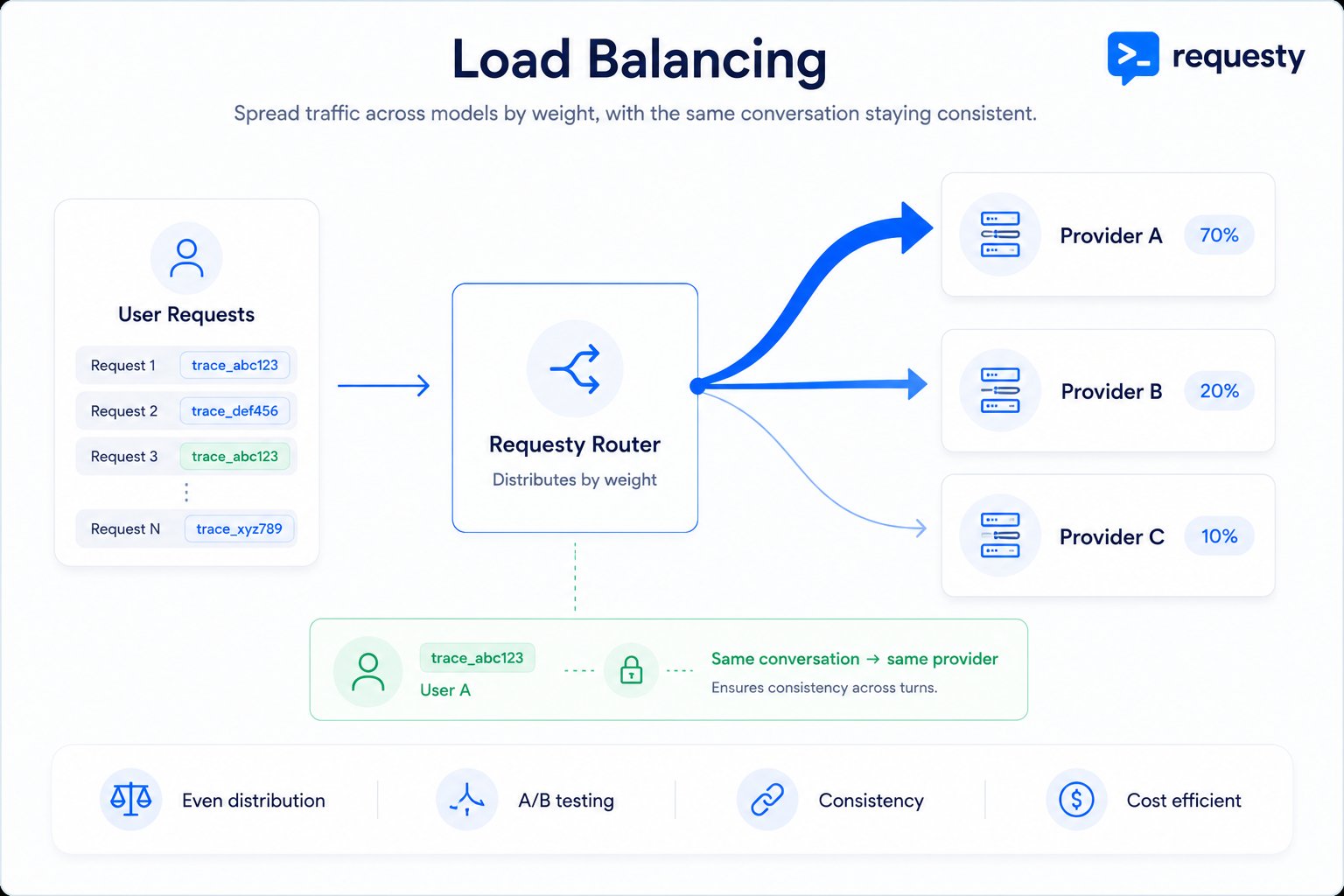 **[Configure load balancing](https://app.requesty.ai/routing-policies)** in the Requesty Console.
## How It Works
You assign **weights** to each model (e.g., 70%, 20%, 10%).
Each incoming request is **consistently routed** to one model based on the distribution.
Requests with the same `trace_id` or `user_id` always go to the **same model**.
## Benefits
Compare model performance with real traffic split across different models.
Send 10% to a new model, 90% to your stable model. Increase gradually.
Route most traffic to cheaper models while keeping premium models available.
Same user always gets the same model, maintaining conversation context.
## Creating a Load Balancing Policy
Go to [Routing Policies](https://app.requesty.ai/routing-policies), click **Create Policy**, and select **Load Balancing** as the policy type.
**[Configure load balancing](https://app.requesty.ai/routing-policies)** in the Requesty Console.
## How It Works
You assign **weights** to each model (e.g., 70%, 20%, 10%).
Each incoming request is **consistently routed** to one model based on the distribution.
Requests with the same `trace_id` or `user_id` always go to the **same model**.
## Benefits
Compare model performance with real traffic split across different models.
Send 10% to a new model, 90% to your stable model. Increase gradually.
Route most traffic to cheaper models while keeping premium models available.
Same user always gets the same model, maintaining conversation context.
## Creating a Load Balancing Policy
Go to [Routing Policies](https://app.requesty.ai/routing-policies), click **Create Policy**, and select **Load Balancing** as the policy type.
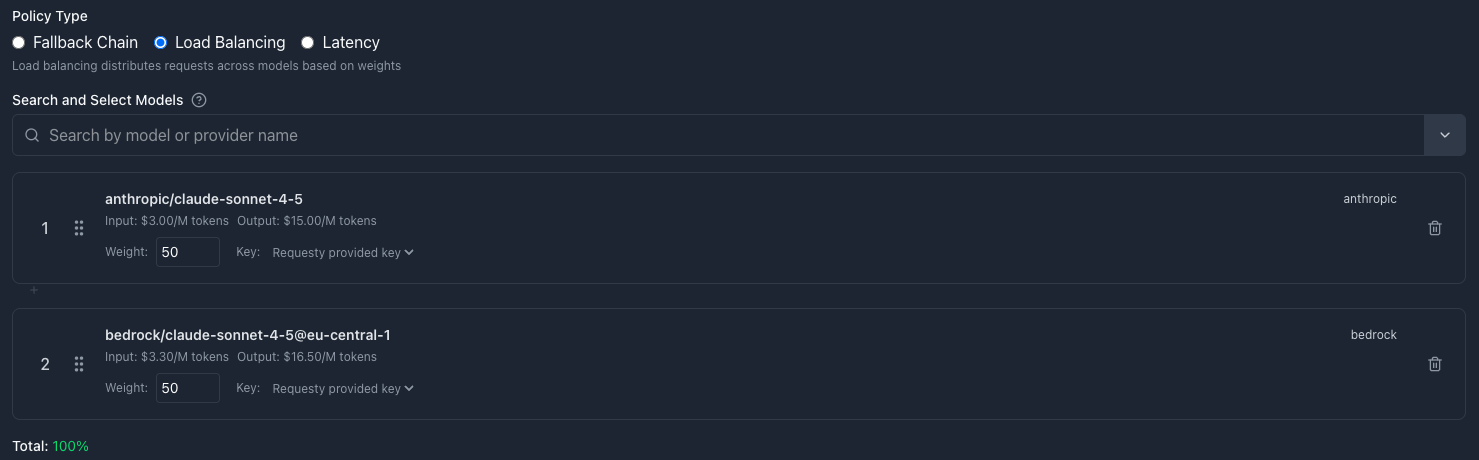 Set up your distribution. For example:
| Model | Weight |
| ---------------------------------------- | ------ |
| `anthropic/claude-sonnet-4-5` | 50% |
| `bedrock/claude-sonnet-4-5@eu-central-1` | 50% |
The total weights must add up to 100% (you can use any numbers, they are normalized).
Reference your policy with `policy/your-policy-name`:
```python Python theme={"dark"}
from openai import OpenAI
client = OpenAI(
base_url="https://router.requesty.ai/v1",
api_key="your-requesty-api-key"
)
response = client.chat.completions.create(
model="policy/sonnet-distribution",
messages=[{"role": "user", "content": "Hello!"}]
)
```
```typescript TypeScript theme={"dark"}
import OpenAI from 'openai';
const client = new OpenAI({
baseURL: 'https://router.requesty.ai/v1',
apiKey: 'your-requesty-api-key'
});
const response = await client.chat.completions.create({
model: 'policy/sonnet-distribution',
messages: [{ role: 'user', content: 'Hello!' }]
});
```
```bash cURL theme={"dark"}
curl https://router.requesty.ai/v1/chat/completions \
-H "Content-Type: application/json" \
-H "Authorization: Bearer your-requesty-api-key" \
-d '{
"model": "policy/sonnet-distribution",
"messages": [{"role": "user", "content": "Hello!"}]
}'
```
## Consistency Guarantee
Load balancing uses **deterministic hashing** to ensure the same user always gets the same model.
| Scenario | Behavior |
| ------------------ | ------------------------------------------------------------- |
| With `trace_id` | All requests with the same `trace_id` route to the same model |
| Without `trace_id` | Requesty generates a unique `request_id` for each request |
This means multi-turn conversations stay on the same model, user sessions get consistent behavior, and A/B test groups are stable.
### Maintaining Consistency Across Requests
To keep a user on the same model across multiple requests, pass a `trace_id`:
```python Python theme={"dark"}
response = client.chat.completions.create(
model="policy/sonnet-distribution",
messages=[{"role": "user", "content": "Hello!"}],
extra_body={
"requesty": {
"trace_id": "user-12345"
}
}
)
```
```typescript TypeScript theme={"dark"}
const response = await client.chat.completions.create({
model: 'policy/sonnet-distribution',
messages: [{ role: 'user', content: 'Hello!' }],
extra_body: {
requesty: {
trace_id: 'user-12345'
}
}
});
```
Use your internal user ID as the `trace_id` to ensure each user gets a consistent model experience while still benefiting from A/B testing.
## Load Balancing Between Policies
You can load balance between **entire routing policies**, not just individual models. This is powerful for canary deployments, A/B testing different routing strategies, and gradual migration from one policy to another.
### Example: Policy Rollout
Say you have two fallback policies and want to gradually shift traffic:
| Policy | Models | Weight |
| ------------------------------------- | -------------------------------------------- | ------ |
| `policy/production-fallback` (stable) | openai/gpt-5.2 → anthropic/claude-sonnet-4-5 | 80% |
| `policy/experimental-fallback` (new) | google/gemini-2.5-pro → openai/gpt-5.2 | 20% |
Create a load balancing policy called `gradual-rollout` with these weights. As you gain confidence, adjust to 50/50, then 0/100.
When load balancing between policies, each policy must be compatible with your request parameters. Do not mix embedding policies with chat completion policies.
## Use Cases
Compare GPT-5.2 vs Gemini 2.5 Pro on real traffic:
| Model | Weight |
| ----------------------- | ------ |
| `openai/gpt-5.2` | 50% |
| `google/gemini-2.5-pro` | 50% |
Track performance in [Analytics](https://app.requesty.ai/analytics) and see which model performs better.
Carefully introduce a new model:
| Model | Weight | Role |
| ---------------- | ------ | -------------- |
| `openai/gpt-4o` | 90% | Stable, proven |
| `openai/gpt-5.2` | 10% | New, testing |
Increase the weight of `gpt-5.2` as you validate quality.
Route most traffic to cheaper models, some to premium:
| Model | Weight |
| -------------------- | ------ |
| `openai/gpt-4o-mini` | 70% |
| `openai/gpt-4o` | 20% |
| `openai/gpt-5.2` | 10% |
Distribute across providers for resilience:
| Model | Weight |
| ----------------------------- | ------ |
| `openai/gpt-5.2` | 40% |
| `anthropic/claude-sonnet-4-5` | 40% |
| `google/gemini-2.5-pro` | 20% |
## Key Selection (BYOK)
For each model in your load balancing policy, you can choose:
| Option | Description |
| ------------------------- | ------------------------------------- |
| **Requesty provided key** | Use Requesty's managed keys (default) |
| **My own key** | Use your BYOK credentials |
## Monitoring and Analytics
Go to [Analytics](https://app.requesty.ai/analytics).
Filter by your policy name to see the **actual distribution** of requests across models.
Compare **latency**, **cost**, and **success rates** between models. The distribution should match your configured weights (±2% variance is normal).
## FAQ
Requesty uses the **xxhash algorithm** on your `trace_id` (or `request_id` if no trace\_id) to deterministically select a model. The same ID always produces the same hash, which maps to the same model.
Changing weights will **re-distribute** traffic. Some users may switch to different models. If you need stability, avoid changing weights frequently, or use separate policies for stable vs experimental traffic.
Yes. Create a load balancing policy that points to **fallback policies**. This gives you both load balancing and automatic failover.
| Policy | Weight |
| --------------------------- | ------ |
| `policy/openai-fallback` | 50% |
| `policy/anthropic-fallback` | 50% |
Yes. All models in a load balancing policy should support the same request format and features. Do not mix chat models with embedding models, or models with different context lengths.
Use a stable `trace_id` (like user ID). With 100+ unique users, the distribution will converge to your configured weights (e.g., 20%). With small sample sizes, expect ±5% variance.
Set up your distribution. For example:
| Model | Weight |
| ---------------------------------------- | ------ |
| `anthropic/claude-sonnet-4-5` | 50% |
| `bedrock/claude-sonnet-4-5@eu-central-1` | 50% |
The total weights must add up to 100% (you can use any numbers, they are normalized).
Reference your policy with `policy/your-policy-name`:
```python Python theme={"dark"}
from openai import OpenAI
client = OpenAI(
base_url="https://router.requesty.ai/v1",
api_key="your-requesty-api-key"
)
response = client.chat.completions.create(
model="policy/sonnet-distribution",
messages=[{"role": "user", "content": "Hello!"}]
)
```
```typescript TypeScript theme={"dark"}
import OpenAI from 'openai';
const client = new OpenAI({
baseURL: 'https://router.requesty.ai/v1',
apiKey: 'your-requesty-api-key'
});
const response = await client.chat.completions.create({
model: 'policy/sonnet-distribution',
messages: [{ role: 'user', content: 'Hello!' }]
});
```
```bash cURL theme={"dark"}
curl https://router.requesty.ai/v1/chat/completions \
-H "Content-Type: application/json" \
-H "Authorization: Bearer your-requesty-api-key" \
-d '{
"model": "policy/sonnet-distribution",
"messages": [{"role": "user", "content": "Hello!"}]
}'
```
## Consistency Guarantee
Load balancing uses **deterministic hashing** to ensure the same user always gets the same model.
| Scenario | Behavior |
| ------------------ | ------------------------------------------------------------- |
| With `trace_id` | All requests with the same `trace_id` route to the same model |
| Without `trace_id` | Requesty generates a unique `request_id` for each request |
This means multi-turn conversations stay on the same model, user sessions get consistent behavior, and A/B test groups are stable.
### Maintaining Consistency Across Requests
To keep a user on the same model across multiple requests, pass a `trace_id`:
```python Python theme={"dark"}
response = client.chat.completions.create(
model="policy/sonnet-distribution",
messages=[{"role": "user", "content": "Hello!"}],
extra_body={
"requesty": {
"trace_id": "user-12345"
}
}
)
```
```typescript TypeScript theme={"dark"}
const response = await client.chat.completions.create({
model: 'policy/sonnet-distribution',
messages: [{ role: 'user', content: 'Hello!' }],
extra_body: {
requesty: {
trace_id: 'user-12345'
}
}
});
```
Use your internal user ID as the `trace_id` to ensure each user gets a consistent model experience while still benefiting from A/B testing.
## Load Balancing Between Policies
You can load balance between **entire routing policies**, not just individual models. This is powerful for canary deployments, A/B testing different routing strategies, and gradual migration from one policy to another.
### Example: Policy Rollout
Say you have two fallback policies and want to gradually shift traffic:
| Policy | Models | Weight |
| ------------------------------------- | -------------------------------------------- | ------ |
| `policy/production-fallback` (stable) | openai/gpt-5.2 → anthropic/claude-sonnet-4-5 | 80% |
| `policy/experimental-fallback` (new) | google/gemini-2.5-pro → openai/gpt-5.2 | 20% |
Create a load balancing policy called `gradual-rollout` with these weights. As you gain confidence, adjust to 50/50, then 0/100.
When load balancing between policies, each policy must be compatible with your request parameters. Do not mix embedding policies with chat completion policies.
## Use Cases
Compare GPT-5.2 vs Gemini 2.5 Pro on real traffic:
| Model | Weight |
| ----------------------- | ------ |
| `openai/gpt-5.2` | 50% |
| `google/gemini-2.5-pro` | 50% |
Track performance in [Analytics](https://app.requesty.ai/analytics) and see which model performs better.
Carefully introduce a new model:
| Model | Weight | Role |
| ---------------- | ------ | -------------- |
| `openai/gpt-4o` | 90% | Stable, proven |
| `openai/gpt-5.2` | 10% | New, testing |
Increase the weight of `gpt-5.2` as you validate quality.
Route most traffic to cheaper models, some to premium:
| Model | Weight |
| -------------------- | ------ |
| `openai/gpt-4o-mini` | 70% |
| `openai/gpt-4o` | 20% |
| `openai/gpt-5.2` | 10% |
Distribute across providers for resilience:
| Model | Weight |
| ----------------------------- | ------ |
| `openai/gpt-5.2` | 40% |
| `anthropic/claude-sonnet-4-5` | 40% |
| `google/gemini-2.5-pro` | 20% |
## Key Selection (BYOK)
For each model in your load balancing policy, you can choose:
| Option | Description |
| ------------------------- | ------------------------------------- |
| **Requesty provided key** | Use Requesty's managed keys (default) |
| **My own key** | Use your BYOK credentials |
## Monitoring and Analytics
Go to [Analytics](https://app.requesty.ai/analytics).
Filter by your policy name to see the **actual distribution** of requests across models.
Compare **latency**, **cost**, and **success rates** between models. The distribution should match your configured weights (±2% variance is normal).
## FAQ
Requesty uses the **xxhash algorithm** on your `trace_id` (or `request_id` if no trace\_id) to deterministically select a model. The same ID always produces the same hash, which maps to the same model.
Changing weights will **re-distribute** traffic. Some users may switch to different models. If you need stability, avoid changing weights frequently, or use separate policies for stable vs experimental traffic.
Yes. Create a load balancing policy that points to **fallback policies**. This gives you both load balancing and automatic failover.
| Policy | Weight |
| --------------------------- | ------ |
| `policy/openai-fallback` | 50% |
| `policy/anthropic-fallback` | 50% |
Yes. All models in a load balancing policy should support the same request format and features. Do not mix chat models with embedding models, or models with different context lengths.
Use a stable `trace_id` (like user ID). With 100+ unique users, the distribution will converge to your configured weights (e.g., 20%). With small sample sizes, expect ±5% variance.